

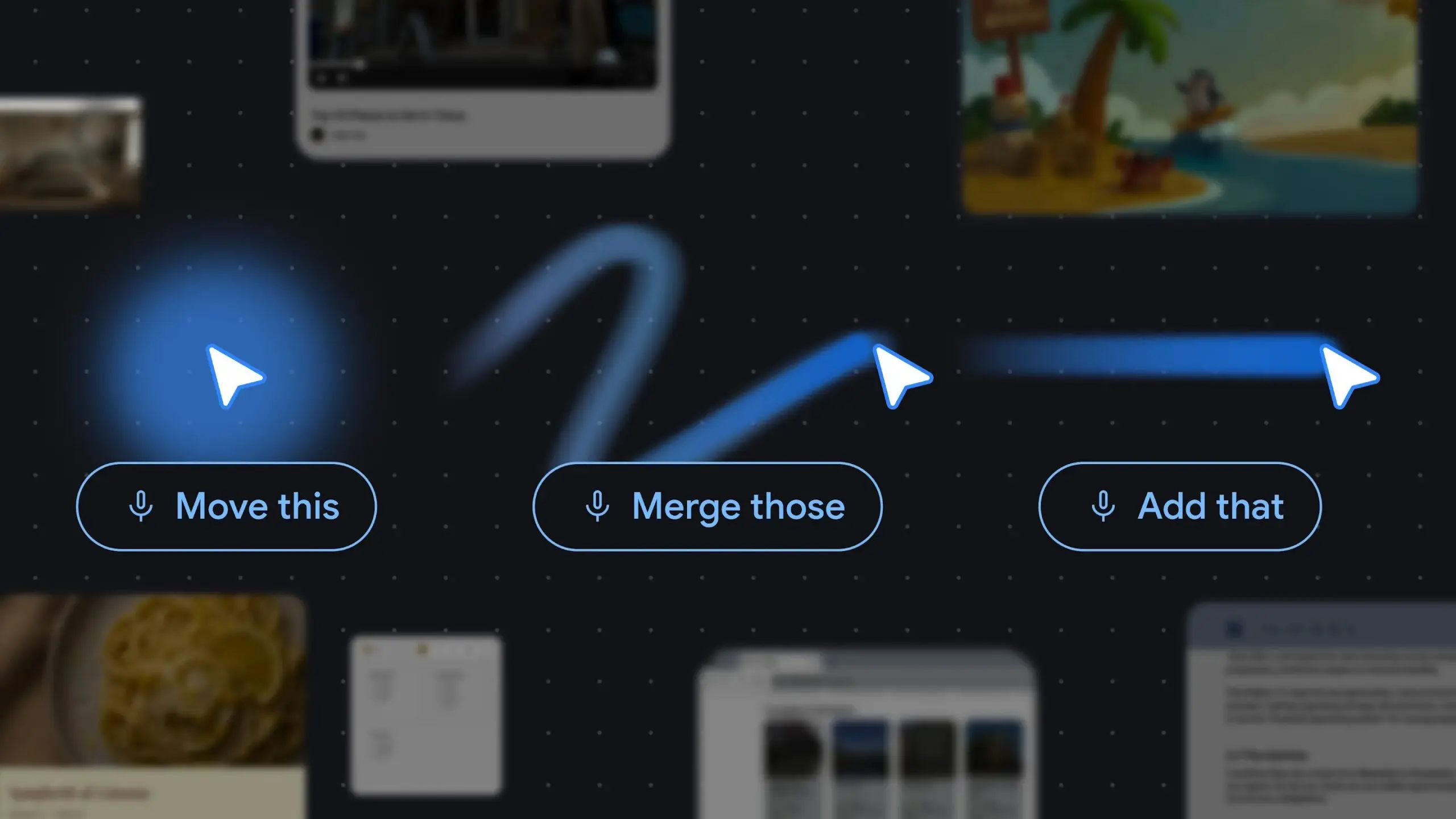
Google DeepMind is redefining a fundamental computing element: the mouse cursor. Just days after unveiling Magic Pointer for its new Googlebooks laptops, the company has confirmed that the same AI-powered cursor experience is now rolling out to Gemini in Chrome. This marks a significant step toward integrating contextual AI into everyday browsing, allowing users to interact with web content without switching between tabs or typing lengthy queries.
The Magic Pointer concept is simple yet transformative. Instead of copying text into a chatbot or writing a detailed prompt, users can simply point their cursor at any element on a webpage—a word, paragraph, image, or even a code block—and ask Gemini for help. The system understands both the user's pointing gesture and the intended action, creating a seamless conversational loop. Google DeepMind describes this as turning "pixels into actionable entities," where the AI recognizes objects, dates, places, and other content directly from the screen.
How Magic Pointer Works
In a detailed blog post, Google DeepMind researchers outlined the thinking behind Magic Pointer. The mouse pointer, they argue, has "barely evolved in more than half a century," remaining a simple pointing device. Magic Pointer leverages Gemini's contextual understanding to infer what the user is looking at and what they want to do with it. For instance, if you point at a product image and say "Compare this," Gemini will identify the product and fetch comparable alternatives. Similarly, pointing to an empty corner of a living room photo and saying "Visualize a couch here" would cause Gemini to render a 3D model into the scene.
The system is designed to handle ambiguity through shared context. Instead of typing "What is the price of this item?" a user could simply point at a price tag and ask "What does this mean?" or "Is this a good deal?" DeepMind emphasizes that the goal is to make AI interactions more human and conversational, relying on physical gestures and natural language together. This reduces the cognitive load of crafting precise prompts, which has been a barrier for many users adopting AI tools.
Rollout and Availability
Google has not specified which regions or user groups will get Magic Pointer in Chrome first. As of now, the feature appears to be in a gradual rollout. Android Authority tested Gemini in Chrome but found no active Magic Pointer capabilities, suggesting a limited or staged deployment. The company has confirmed that the more advanced features—such as real-time object recognition and complex scene manipulation—are currently planned for Googlebooks, which have dedicated hardware optimizations. The Chrome version may focus on simpler tasks like product comparison, summarization, and quick lookup.
Background and Context
Magic Pointer is part of a broader Google initiative to embed AI deeper into the user interface. The company has already integrated Gemini into Chrome's sidebar, Gmail, Docs, and other services. This new cursor feature represents a shift from text-based chat to gesture-driven interaction. It builds on research from Google's Project Astra, which aimed to create a universal AI assistant that could see, hear, and act across applications. By bringing Magic Pointer to Chrome, Google is positioning Gemini as a genuine competitor to AI features in Microsoft Edge (Copilot) and Apple's upcoming AI enhancements.
The timing is strategic. With the launch of Googlebooks—a new line of AI-first laptops—Google is betting on hardware-software synergy. The laptops include dedicated AI chips that can run Gemini models locally, reducing latency. However, extending Magic Pointer to Chrome means that even users without Googlebooks can benefit, albeit with cloud-based processing. This dual approach could help Google gather feedback and refine the system before a wider push.
Technical Insights and Challenges
From a technical standpoint, Magic Pointer requires real-time image and text analysis. When a user points at a region on the screen, Gemini must identify the foreground object, understand its context, and execute a relevant action. DeepMind researchers note that this involves fusing information from the screen buffer with mouse coordinates and audio commands. One of the hurdles is handling dynamic content like videos or scrolling feeds. The system must track the cursor's target as the page changes, which demands low-latency processing.
Privacy is another consideration. Since Magic Pointer processes screen content, Google likely processes this data on-device or within a secure cloud session. The company has not detailed specific privacy measures for the Chrome rollout. Historically, Gemini's cloud-based features have been subject to data handling policies that allow Google to use interactions for model improvement unless users opt out. Users concerned about privacy may need to review their Chrome settings.
Magic Pointer also raises questions about accessibility. For users with motor impairments who rely on keyboard navigation or voice control, pointing may not be the primary input. Google has not yet clarified whether Magic Pointer will support alternative input methods like head tracking or eye gaze. The feature as described assumes a traditional mouse or trackpad, which could limit its reach. However, the underlying AI—understanding screen elements from coordinates—could theoretically be adapted to other input sources.
Implications for the Future of Browsing
If Magic Pointer gains traction, it could fundamentally change how people interact with the web. The traditional browsing model involves reading, clicking links, and filling forms. With an AI cursor, users might skip steps by simply pointing and asking. For example, instead of manually comparing flight prices across tabs, you could point at a search result and say "Find cheaper alternatives." This moves the browser from a passive window into an active assistant.
Competitors are not standing still. Microsoft's Copilot in Edge already offers context-aware sidebars and page summarization, though it lacks the precise pointing capability. Apple's intelligence features use machine learning to recognize objects in photos and text, but they operate within apps rather than the browser. Google's advantage lies in its massive web index and deep learning models that have seen billions of screens. Magic Pointer could eventually extend to Android's version of Chrome, enabling mobile users to point on a touchscreen or use AI vision to scan their surroundings.
What This Means for Users
For everyday users, Magic Pointer promises to reduce friction. Tasks like researching products, understanding complex topics, or extracting data from images become one-step operations. The feature also enhances accessibility for users who struggle with typing or reading small text—though, as noted, the pointing requirement may be a barrier for some. Early adopters can expect a gradual rollout, with Google likely using telemetry to refine the experience. The company has a history of piloting features in Chrome before wider release.
The combination of Magic Pointer with Gemini's existing capabilities—such as text generation, code explanation, and visual analysis—creates a powerful toolset. Users can point at a chart and ask for a summary, or point at a form field and ask Gemini to fill it based on previous data. The system is designed to learn from context, so repeated actions become faster over time.
One of the most intriguing possibilities is in education and research. Students could point at a historical document and ask for its significance, or point at a scientific diagram and request an explanation. Journalists might use it to fact-check claims quickly. The cursor becomes a digital research assistant, always ready to help without needing explicit conversations.
Google DeepMind's blog post emphasizes that the magic of Magic Pointer lies in its ability to "meet users across all the tools they use, without interrupting their flow." This philosophy aligns with Google's broader strategy of embedding AI into every product. The mouse cursor, a 50-year-old input method, is getting an upgrade that may set a new standard for human-computer interaction. As the rollout continues, users will discover new ways to blend pointing and speaking, making the web not just a source of information, but an active partner in discovery.
Source: Android Authority News