

)
Trump China Visit Live Updates: A Superpower Summit in Beijing
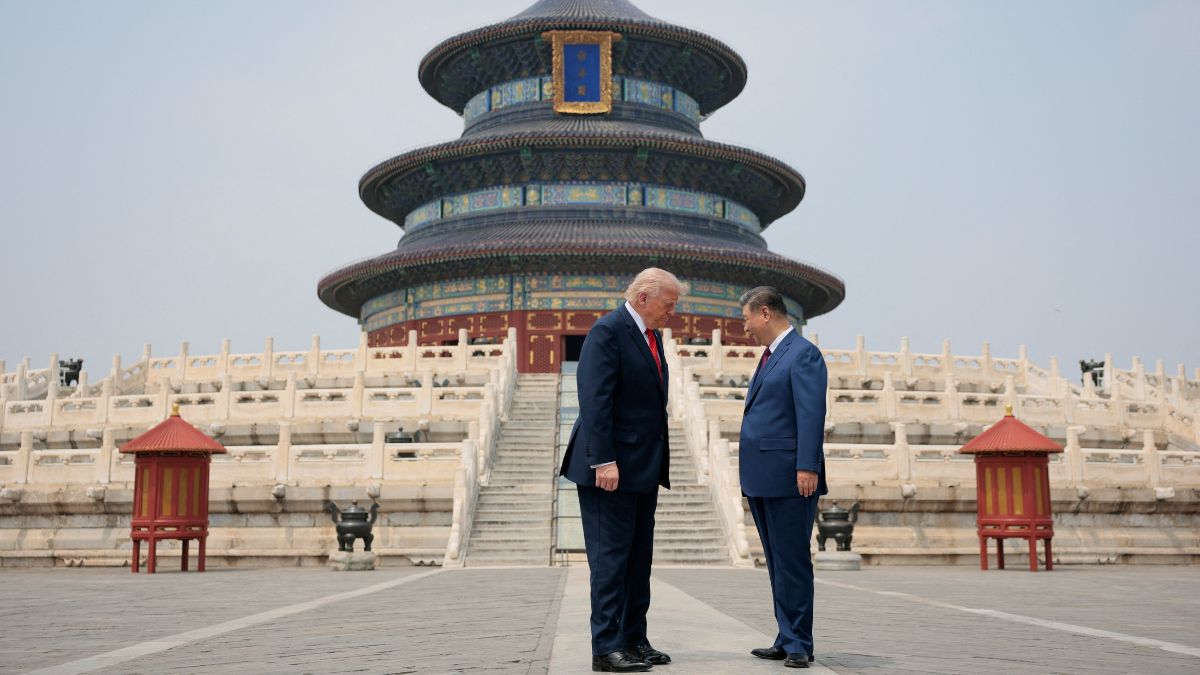
US President Donald Trump arrived in Beijing on Wednesday evening aboard Air Force One, accompanied by a delegation of top American CEOs including Tesla's Elon Musk, Nvidia's Jensen Huang, and Apple's Tim Cook. The two-day summit with Chinese President Xi Jinping, which began on Thursday, May 14, 2026, was aimed at addressing a wide range of contentious issues—from trade imbalances and technology competition to the war in Iran and the status of Taiwan. After a morning of formal talks at the Great Hall of the People, Trump and Xi toured the historic Temple of Heaven, a UNESCO World Heritage site that has been a symbol of Chinese imperial authority for centuries.
Morning Diplomacy: Red Carpets and Closed-Door Talks
The day began with a carefully choreographed welcome ceremony at the Great Hall of the People, an opulent government building that overlooks Tiananmen Square. Trump and Xi walked together along a red carpet lined with uniformed soldiers and schoolchildren waving Chinese and American flags. The atmosphere was one of calculated warmth—Trump praised Xi as "a great leader" and expressed that it was "an honor to be your friend." Xi, in more measured terms, welcomed Trump back to China after nine years and reminded him that the world was at a "crossroads." He urged the two nations to become "partners, not rivals" and stressed that a stable US-China relationship was "a boon for the world."
During their closed-door meeting, which ran over by half an hour, the leaders addressed a host of pressing issues. Xi raised the Taiwan question early on, warning that if mishandled, it could lead to "conflict" and "push the entire China-US relationship into a very dangerous situation." This was a stark opening salvo, underscoring Beijing's red line on the self-governing island. On trade, Xi noted that US and Chinese trade officials had achieved a "generally balanced and positive outcome" in preliminary talks held in South Korea—a reference to negotiations between US Treasury Secretary Scott Bessent and Chinese Vice Premier He Lifeng. The Chinese president reiterated that "there are no winners in a trade war" and that the essence of bilateral economic relations is "mutual benefit and win-win cooperation."
Trump, for his part, spoke effusively about the future. "We're going to have a fantastic future together," he told Xi, and later described the meeting to reporters as "great." The US president also signaled his intention to propose a trilateral agreement among the US, China, and Russia to cap their nuclear arsenals. A senior administration official briefed reporters before the trip that Trump wanted to replace the expired New START Treaty with what he called a "new, improved, and modernized" arrangement that would include China for the first time.
Business Leaders in the Room
A notable feature of the summit was the presence of a high-powered business delegation. Alongside Trump were not only his senior aides—Secretary of State Marco Rubio, Defense Secretary Pete Hegseth, and Senior Advisor Steven Miller—but also the CEOs of some of America's most influential companies. Elon Musk, Jensen Huang, Tim Cook, Boeing's Kelly Ortberg, Meta's Dina Powell McCormick, and BlackRock's Larry Fink all attended portions of the talks. When they emerged from the Great Hall, Musk described the meeting as "wonderful" and said "many good things" were achieved. Huang echoed that sentiment, stating that the "meetings went well."
Trump explained the presence of the executives by saying he had asked them to come "to pay respects" to Xi and to expand business ties. "We asked the top 30 in the world. Every single one of them said yes, and I didn't want the second or third in the company. I wanted only the top," Trump said during his opening remarks. Xi responded by telling the business leaders that China "will open wider" to the world, and that American companies would "enjoy even brighter prospects in China."
This display of corporate unity was itself a diplomatic tool. By showcasing CEOs from sectors ranging from electric vehicles and artificial intelligence to social media and finance, Trump aimed to signal that the US business community remained deeply invested in the Chinese market—even as Washington pursued a policy of "de-risking" sensitive supply chains. For Xi, the presence of these executives provided an opportunity to reaffirm China's commitment to foreign investment and market access, at a time when Western criticism of China's business environment had intensified.
Cultural Diplomacy at the Temple of Heaven
After the bilateral talks, Trump and Xi headed to the Temple of Heaven, a sprawling religious complex in the southern part of central Beijing that was built in the early 15th century. The site was once used by Chinese emperors to perform rituals and pray for good harvests, and it has been recognized by UNESCO as a masterpiece of architectural and landscape design. Trump became only the second sitting US president to visit the temple, following Gerald Ford, who toured it in 1975. Notably, Henry Kissinger, the diplomat who helped normalize US-China relations in the 1970s, had visited the landmark 15 times over his long career.
Dressed in suits, Trump and Xi walked shoulder to shoulder through the complex, pausing to pose for photographs with members of the delegation. The mood appeared relaxed—Trump was seen pointing at the intricate woodwork and colorful glazed tiles, while Xi explained the historical significance of the Hall of Prayer for Good Harvests. The visit was covered extensively by Chinese state media, which framed it as a symbol of the two leaders' personal rapport and mutual respect.
Observers noted that the Temple of Heaven visit was part of a broader Chinese strategy to use cultural symbolism to create a favorable atmosphere for negotiations. Minutes before the photo-op, China announced that it had renewed export licenses for more than 400 US beef processing plants, reversing a lapse in permissions that had affected roughly 65% of once-registered facilities. Analysts described the move as a goodwill gesture intended to signal flexibility on trade, even as the core geopolitical disputes remained unresolved.
Expert Analysis: Has Trump Accepted China's Victory?
The summit took place against a backdrop of growing debate among international relations scholars about the shifting balance of power. In an analysis published by Firstpost, Prof. Sriparna Pathak, a China expert at the Jindal School of International Affairs, argued that Trump's behavior during the trip suggested he had "admitted defeat" in his China strategy. "He had all the cards when he assumed office but has none today," Pathak said. She noted that Trump had dismantled key alliances such as the Quad and Aukus, abandoned the Trans-Pacific Partnership, and imposed tariffs that failed to rebalance trade. Now, she argued, he was seeking accommodation with China—a de facto "G-2" partnership that would formalize US acceptance of China's rise.
Others took a less dramatic view. They pointed to the fact that the US economy remained larger and technologically more advanced than China's, and that the CEOs accompanying Trump were still betting on China's market but not its political system. Yet the tone of the summit—with Trump repeatedly praising Xi and avoiding any public criticism of Chinese policies on Taiwan, Tibet, or human rights—reinforced a narrative that the US president was prioritizing commercial and strategic stability over confrontation.
Taiwan, Nuclear Arms, and Other Sticking Points
Beyond the photo opportunities and ceremonial exchanges, the summit grappled with several issues that could define US-China relations for years to come. Taiwan was the most sensitive. While the US side publicly reiterated its commitment to a "One China" policy and expressed "clear and firm support" for the island's democracy, Beijing's position was unambiguous. Xi told Trump that the Taiwan question was "the most important issue in China-US relations" and that any mishandling could lead to "clashes or even conflicts."
On nuclear arms, Trump's proposal for a trilateral cap with China and Russia faced an uncertain reception. China's nuclear arsenal, though much smaller than those of the US and Russia, has been growing rapidly. Beijing has historically refused to join arms control negotiations, arguing that its stockpile is minimal and that the two superpowers should first reduce their own arsenals to Chinese levels. However, Trump's willingness to put the issue on the table—even if no agreement was reached—signaled a departure from the previous administration's approach of ignoring the topic.
Another contentious subject was the ongoing Iran war. The US and China have taken sharply different positions: while Washington has led a coalition against Iran, Beijing has maintained economic ties with Tehran and called for restraint. Trump did not publicly pressure Xi on Iran during the summit, but behind closed doors, the issue was likely part of the discussion. Similarly, tensions over the South China Sea and the war in Ukraine were not mentioned in official readouts but were almost certainly on the agenda.
A Day of Celebration and Uncertainty
By late afternoon, after the cultural visit and the state banquet, the summit appeared to have yielded a combination of symbolism and small but tangible steps. China's renewal of US beef licences was a concrete gesture, as was Xi's promise to open China's doors wider. Trump's warm rhetoric and the CEOs' upbeat comments suggested a short-term atmosphere of cooperation.
But unresolved questions lingered. Taiwan remained a flashpoint—Taiwan's Foreign Minister Lin Chia-lung had stated before the summit that Taipei hoped "there are no surprises" from the meeting. On trade, while both sides spoke of positive outcomes, no major deal was announced. And the nuclear arms proposal, though innovative, faced a long and uncertain road. As the two leaders prepared for Friday morning's tea and lunch—the final items on the two-day schedule—the world watched to see whether this summit would mark a genuine reset or merely a pause in the deep structural competition between the world's two largest economies.
Source: Firstpost News