

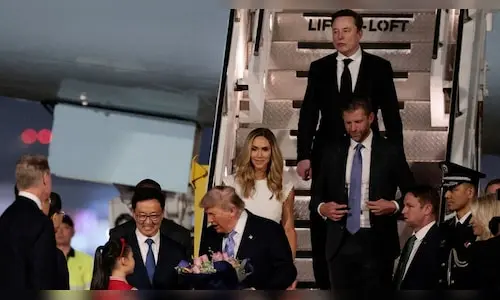
Elon Musk, the world's richest person and CEO of Tesla, SpaceX, and X, has once again courted controversy by leaving the United States without permission from a federal judge. The tech billionaire is currently on recall status in his high-stakes $150 billion lawsuit against OpenAI, the artificial intelligence research organization he co-founded in 2015. Despite a clear warning from Judge Yvonne Gonzalez Rogers — who told Musk on April 30, "Mr Musk, you are not excused, but you can leave for the day" — Musk decided to join President Donald Trump on a state visit to China from May 13 to 15.
The Lawsuit and the Recall Status
The lawsuit, filed in early 2025, accuses OpenAI and its major investor Microsoft of abandoning the nonprofit mission that originally defined the organization. Musk claims that OpenAI, now led by CEO Sam Altman and President Greg Brockman, has become a profit-driven entity that prioritizes shareholder value over the safe and ethical development of artificial general intelligence (AGI). He is seeking approximately $150 billion in damages, which would be paid to an OpenAI nonprofit, and demands that Altman and Brockman be removed from their positions.
During the trial in a California federal court, Musk testified for several days. At the conclusion of his testimony, Judge Rogers placed him on recall status, meaning he could be called back to the witness stand at any moment before the trial concludes. This is a common practice in civil trials where a witness may be needed to clarify or rebut new evidence. According to court transcripts, Rogers explicitly told Musk, "You are not excused, but you can leave for the day." OpenAI's lawyers had requested that Musk remain subject to recall, arguing that his testimony was critical to their defense.
Sources familiar with the matter told NBC News that Musk departed the United States without obtaining the court's permission. Legal experts emphasize that recall status does not involve any physical monitoring, such as an ankle bracelet. It is a legal obligation that relies on the witness's cooperation and the court's expectation. However, when a witness chooses to leave the country, the onus is on their legal team to ensure the judge is informed and approves the absence. Jeffrey Bellin, a law professor at Vanderbilt University, commented, "If I were the attorney, I would have made sure that if my witness is subject to recall and he's left the country, that the judge is OK with that."
Trump's State Visit to China
President Donald Trump's three-day trip to China, from May 13 to 15, was billed as a strategic state visit aimed at deepening bilateral trade agreements and addressing tensions over technology, intellectual property, and territorial claims in the South China Sea. Musk, a close advisor to Trump and a prominent figure in the administration's technology policy, was invited to join the delegation. The Tesla CEO has often positioned himself as a bridge between the U.S. and China, home to Tesla's largest factory and a critical market for his electric vehicles and energy products.
Musk's presence in China during an ongoing legal battle raises questions about his prioritization of business and political alliances over personal legal obligations. However, as of Wednesday, the final day of evidence in the trial, Musk had not been recalled. Closing arguments are set for Thursday, and a jury could return a verdict as early as next week. The practical risk of Musk's absence appears to have passed without incident this time, but the judge may still address the matter after the trial concludes.
Background of the OpenAI Conflict
OpenAI was founded as a nonprofit in 2015 by Elon Musk, Sam Altman, Greg Brockman, Ilya Sutskever, and others, with the mission to ensure that artificial general intelligence benefits all of humanity. Musk contributed significant funding and technical expertise in the early years. However, he left the board in 2018, citing potential conflicts of interest with Tesla's work on AI for autonomous driving. The organization later restructured into a capped-profit company, OpenAI LP, which attracted billions of dollars in investment from Microsoft.
Musk has been a vocal critic of this shift, alleging that Altman and Brockman betrayed the founding principles. In a series of public statements and legal filings, he has portrayed himself as a defender of ordinary people against the dangers of unchecked AI development and the greed of Silicon Valley titans. The case has drawn widespread attention because it involves some of the most powerful figures in technology and raises fundamental questions about the governance of artificial intelligence.
OpenAI's lawyers have argued that Musk's departure was amicable and that changes in the organization's structure were necessary to raise the capital required to compete with tech giants like Google and Meta. They maintain that the capped-profit model still adheres to the mission of broadly distributing benefits, albeit with a focus on attracting investors.
Legal and Ethical Implications
While Musk's trip to China has not yet resulted in legal consequences, it highlights the tension between high-profile business leaders and the judicial system. Legal experts are divided on whether the judge will take any action, such as imposing a fine or issuing a contempt order, especially since the trial is nearly over. Some argue that Musk's conduct sets a dangerous precedent, while others note that recall status is typically managed informally.
The case also underscores the broader discomfort around how the ultra-wealthy navigate legal obligations. Musk has a history of controversial statements and behaviors in legal contexts, including a defamation lawsuit he won in 2022 and a Securities and Exchange Commission settlement over tweets about taking Tesla private. In this trial, his decision to leave the country without explicit approval may be seen as another example of his willingness to challenge authority.
Meanwhile, the jury is expected to deliberate soon. If the verdict favors Musk, OpenAI could be forced to restructure and pay massive damages, potentially reshaping the AI industry. If OpenAI wins, it could validate its current corporate structure and embolden other AI firms to adopt similar models. Either outcome will have lasting implications for the development of artificial intelligence, the role of nonprofits in technology, and the power dynamics between founders who leave and those who remain.
Source: CNBCTV18 News