

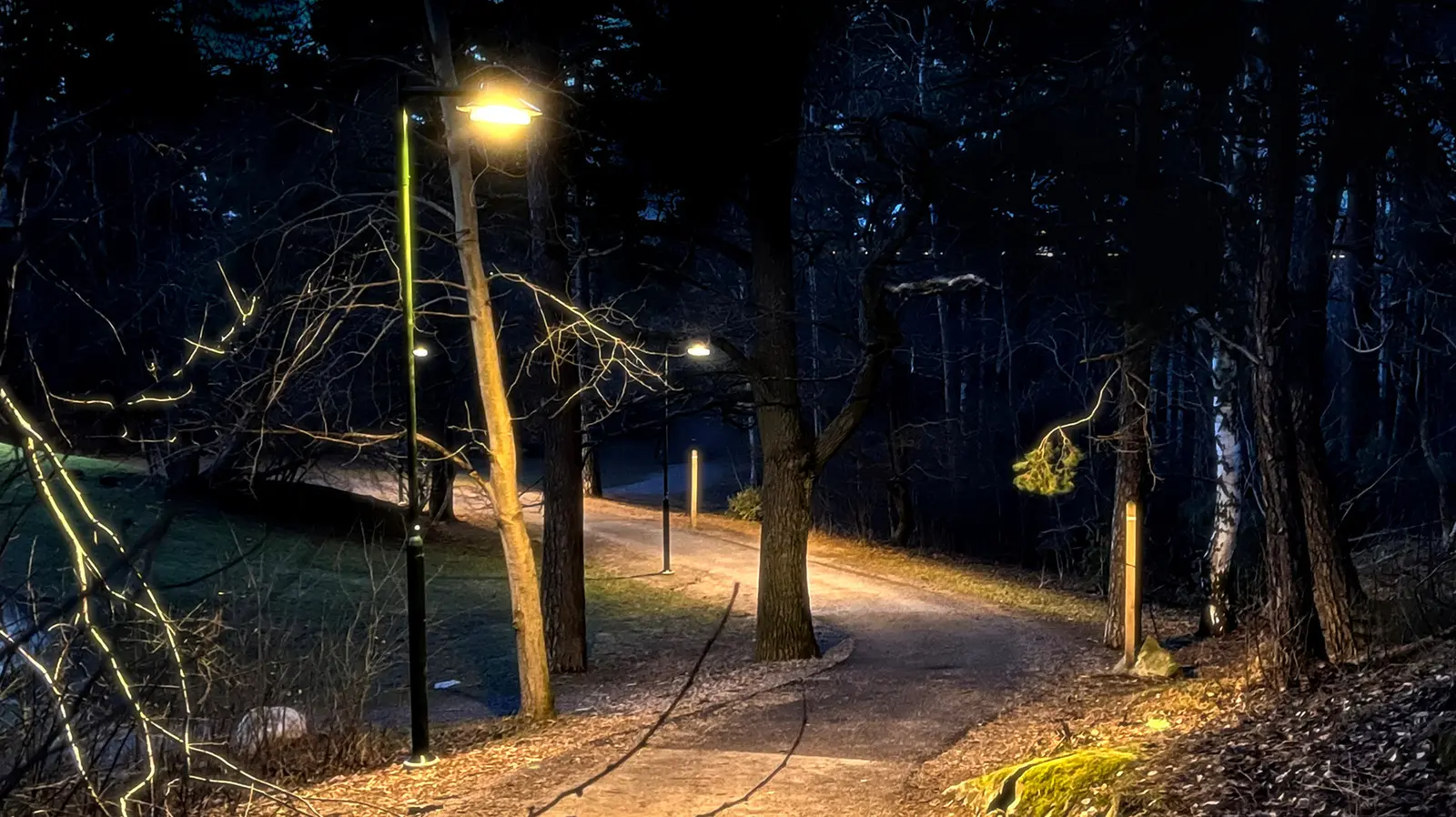
When many people think of urban development, they picture taller skyscrapers, faster electric vehicles, or sprawling smart city networks. But in the heart of Stockholm, Sweden, a quieter revolution is taking place—one that uses light to serve both people and the planet. The city has launched a pilot program in the Årstskogen nature reserve, testing dual-color LED streetlights designed to minimize harm to nocturnal wildlife while keeping paths safe for residents. This holistic approach aligns with Sweden's broader sustainability goals, which prioritize ecological balance alongside technological progress.
The experiment, a collaboration between the Stockholm Environmental Administration and lighting company OrangeTek, began in 2022 and is still ongoing as of May 2026. It employs OrangeTek's CitiSun Dual Color LED lights, which can shift between two modes: monochromatic amber light that contains no blue wavelengths, and warm white light ranging from 2200K to 3000K. The amber light is intended to be far less disruptive to bats and other insects, which are highly sensitive to blue light. Blue light scatters more easily in the atmosphere and can interfere with the navigation of nocturnal animals, altering their flight paths and feeding behaviors—a phenomenon well documented by Science Direct studies.
To test the effectiveness of this approach, the reserve divided the area into two sections. In the first, the lights automatically switch from the warm white (2200K/3000K) setting to the amber monochromatic mode based on a pre-set timer, usually after dusk when most human activity ceases. In the second, motion sensors trigger the warmer white light only when pedestrians or cyclists are detected; otherwise, the lights remain in the amber, bat-friendly state. This sensor-based method aims to maximize energy savings and ecological benefit by keeping the area dark or dim amber until someone needs illumination.
As of yet, OrangeTek has not released official findings from the pilot, so its long-term efficacy remains under review. However, the project has already sparked interest among urban planners, ecologists, and lighting designers worldwide. The core idea—that lighting can be dynamic and species-specific—is gaining traction. Stockholm isn't alone in pushing the boundaries of streetlight innovation. Cities across the globe are experimenting with light color, intensity, and smart triggers to address environmental and health issues.
How Other Cities Are Using Light for Road and Ecological Innovation
One of the most visually striking examples comes from the Netherlands. Studio Roosegaarde, a Dutch design firm, created a 500-meter "smart highway" that glows with neon green strips at night, evoking the atmosphere of the film "Blade Runner." The road uses photo-luminescent paint that charges during the day and emits light after dark, eliminating the need for traditional streetlights in that stretch. More recently, the Netherlands also introduced a glow-in-the-dark bike path styled after Vincent van Gogh's "Starry Night." While the path is largely aesthetic, it demonstrates how lighting can be integrated into public art, making infrastructure both functional and emotionally resonant.
Across the globe, Malaysia took a more utilitarian approach. In 2024, the Malaysian government tested glow-in-the-dark road markings on rural highways to improve visibility without relying on continuous streetlighting. Initial feedback indicated that the markings did enhance road visibility, particularly during heavy rain or fog. However, officials ultimately halted expansion plans, citing two main issues: cost and climate. The humid tropical weather accelerated degradation of the phosphorescent materials, driving up maintenance expenses. Decision-makers concluded that the marginal safety improvement did not justify the higher cost compared to traditional reflective paint. The Malaysian case underscores the importance of local context—what works in a temperate European climate may falter in Southeast Asia's humidity.
Meanwhile, several European cities have chosen to redesign their streetlight color specifically to protect bats. In Metz, France; Worcestershire, England; and Gladsaxe, Denmark, authorities have installed red or amber streetlights in nature-rich areas. Bats are especially sensitive to white and blue-white light, which can deter them from foraging along hedgerows or near water bodies. Red light, with its longer wavelength, appears dimmer to bats and causes less disruption to their echolocation. These red-light zones have been well received by ecologists, but not always by residents. In Odense, Denmark, citizens complained that the red lights made streets feel "creepy" and disorienting, highlighting the tension between wildlife conservation and human comfort.
How Light Pollution Affects Humans
The conversation around outdoor lighting isn't just about animals. Humans, too, are biological creatures whose internal clocks are governed by light. A groundbreaking 2026 study from Harvard University linked modern LED streetlights—especially those with high blue-wavelength output—to disruption of circadian rhythms. Blue light suppresses the production of melatonin, the hormone that regulates sleep, leading to poorer sleep quality and a cascade of potential health problems. The Harvard researchers found correlations between exposure to blue-rich street lighting and increased risks of mental health disorders, obesity, diabetes, and even certain cancers. However, the study's authors caution that correlation does not equal causation; urban areas with intense light pollution also tend to have higher concentrations of other environmental carcinogens and stressors.
Beyond streetlights, everyday technology contributes to blue light exposure. Smartphones, tablets, computer monitors, and televisions all emit blue light, often at close range and for extended periods. Research has shown that cumulative blue light exposure can accelerate retinal damage and increase the rate of macular degeneration, particularly in older adults and those with compromised immune systems. As a result, many device manufacturers now include built-in anti-blue light settings, such as "night mode" or "blue light filter," which shift the display's color temperature to warmer hues. While the scientific debate over the efficacy of blue-light-blocking glasses continues, there are proven habits that can protect your eyes: using dark mode interfaces, applying artificial tears, investing in a humidifier to prevent dry eyes, and—most importantly—taking regular breaks from screens. The American Optometric Association recommends the 20-20-20 rule: every 20 minutes, look at something 20 feet away for at least 20 seconds.
These converging lines of evidence—from bat behavior to human circadian science—are reshaping how cities approach public lighting. Stockholm's Årstskogen trial is just one example of a broader shift toward "biological lighting" that respects the needs of all species. As urban populations grow, the demand for safe streets will only increase, but so will the awareness that light is not just a tool for visibility; it is an environmental force that can heal or harm. The future of streetlights may well be multi-colored, sensor-driven, and dynamically responsive—a quiet revolution burning at the edge of every lamppost.
Source: SlashGear News