

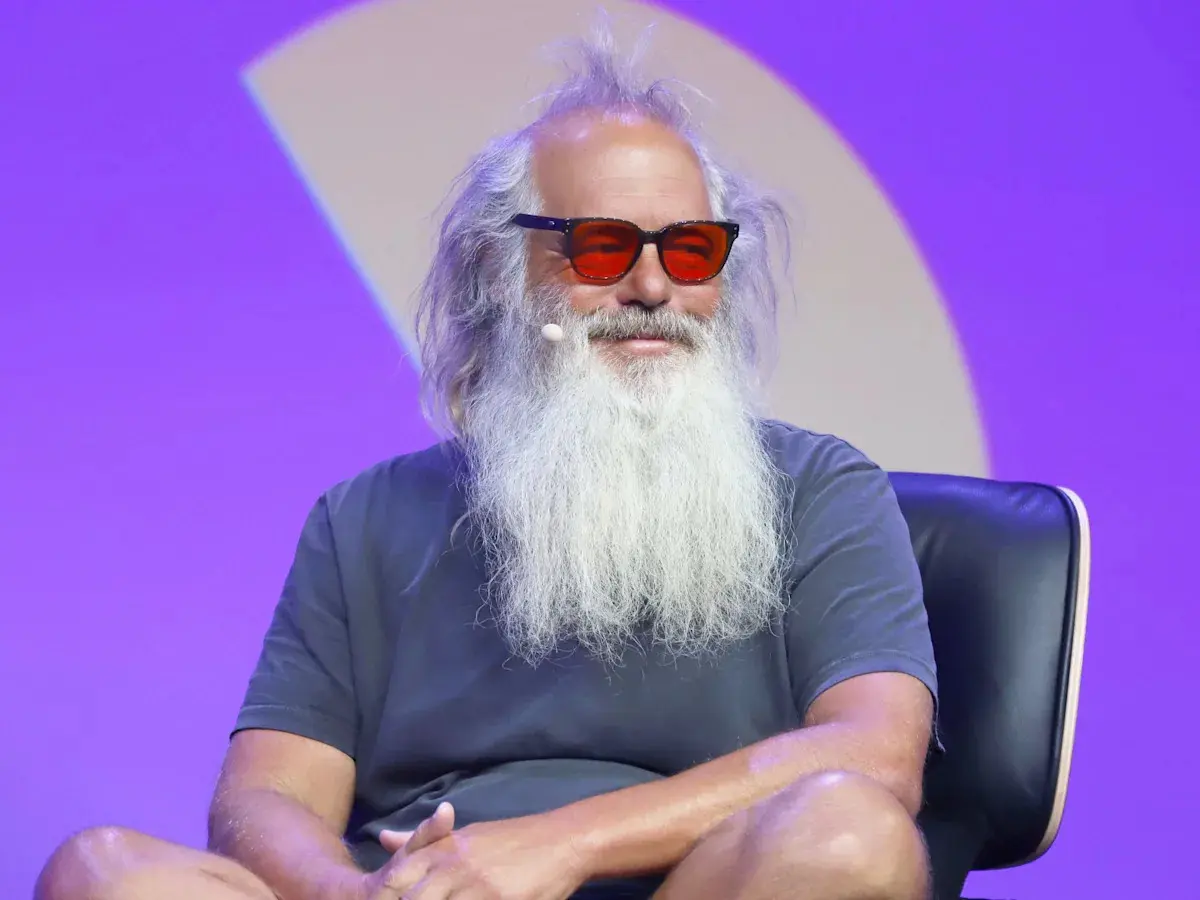
Grammy award-winning record producer Rick Rubin, 63, says his success comes down to discipline and showing up. In a recent episode of the "David Senra" podcast, Rubin reflected on his own work ethic and what drives the world's most successful artists.
“I don’t like to quit. I like to see things through. When I start something, I like to see what it can be,” the cofounder of Def Jam Recordings and founder of American Recordings told host David Senra. Rubin’s career spans four decades and includes work with artists from the Beastie Boys to Johnny Cash, Adele to the Red Hot Chili Peppers. Yet despite his zen-like public image, he admits that working hard does not come naturally.
“I’m a lazy workaholic,” Rubin said. “I have to force myself to do it. But I do force myself. My demeanor would be to do nothing.” This paradoxical self-description captures the internal struggle of many creative professionals: the desire to produce great art versus the natural pull toward rest and leisure. For Rubin, the key is not waiting for inspiration but building routines that override inertia.
Rubin elaborated that the real motivator is the finished product—the “beautiful thing” that makes the drudgery worthwhile. “That’s the point. So, I love the beautiful thing, and it takes a lot of work to get to the beautiful thing,” he said. He described sharing music with the world as “a great feeling,” but acknowledged that the path to that moment is often grueling. “All of the work up until then, it’s like, ‘Oh my god, I have to go to the studio today.’”
He painted a vivid picture of his early days in New York City: “It’s such a beautiful day. Wouldn’t it be nice to just go out and have lunch with friends? But my whole life has been, you know, most of my life in the first 25 years was in a dark room for 16 hours a day, 7 days a week in New York City, working on music.” Rubin’s foundation of Def Jam began in a dorm room at New York University, where he started the label with Russell Simmons. From those humble beginnings, he produced landmark albums like the Beastie Boys’ “Licensed to Ill” and LL Cool J’s “Radio.” Later, under the American Recordings banner, he revived Johnny Cash’s career with the stark “American Recordings” series.
Rubin admitted that parts of the creative process are “boring,” and that there are times when he’d “rather not be there.” But the most addictive part, he said, is the “moment of revelation”—when a project suddenly transforms from “nothing to something really good.” This epiphany often comes after a long stretch of trial and error, and it is what keeps him coming back to the studio each day.
He also cited Eminem as a prime example of relentless discipline. Rubin previously called the rapper the “most obsessive artist” he has ever worked with. On the podcast, he elaborated: “It feels like his entire life is centered around writing words. He’s totally preoccupied with that. So, he always has a notebook. He’s always making little notes.” Rubin recalled once asking Eminem whether the notes were for a new song. “He’s like, ‘No, I’m just like keeping active, keeping active in the skill set.’” This constant practice, Rubin noted, is what separates great artists from merely talented ones.
Still, Rubin acknowledged that work ethic manifests differently across individuals. “Work ethic is always a part of it, but for some people, work ethic is the reason they are who they are. And there are other people who are just incredibly talented and have enough work ethic to get over the finish line,” he said. This nuanced view reflects his experience working with hundreds of musicians, each with their own relationship to discipline and creativity.
Rubin’s own career is a testament to the power of showing up. He has won nine Grammy Awards and produced dozens of multi-platinum albums. He helped shape the sound of hip-hop, alternative rock, and country music, often blending genres in ways that seemed counterintuitive but paid off. His work with the Red Hot Chili Peppers on “Blood Sugar Sex Magik” and “Californication” brought the band global stardom. He also produced Adele’s “25,” one of the best-selling albums of all time. In addition to music production, Rubin co-founded the yoga and meditation company Inner Voyage, reflecting his interest in mindfulness—a practice that likely helps him balance his “lazy” tendencies with his workaholic drive.
The concept of a “lazy workaholic” resonates in the broader culture of entrepreneurship and high performance. Many successful figures describe themselves as naturally unmotivated but disciplined. Selena Gomez, who founded Rare Beauty in 2019, credits her grandfather’s philosophy: “If you are on time, you’re already late.” She arrives 30 minutes early to appointments. Nvidia CEO Jensen Huang, a self-proclaimed “always in a state of anxiety,” runs the company seven days a week and says fear of failure drives him more than desire for success.
For Rubin, the lesson is clear: talent alone is not enough. “You have to put in the work even when you don’t want to,” he said. “And that’s something I remind myself of every day.” His advice to aspiring artists mirrors his own practice: set a schedule, show up, and trust that the moment of revelation will come—as long as you keep grinding through the boredom and the beautiful days.
Source: Yahoo Entertainment News